Showing posts with label FFT. Show all posts

Thursday, July 2, 2015

A Day Out Along the Wall - Part One

I came to see the wall - and was not disappointed. Yesterday I spent a solid 12 hours journeying to, along and back from Hadrian’s Wall. Getting there was an adventure - I was grateful for the friendly driver of the AD122 bus. It felt like I had a personal chauffeur as quite often I was the only person on the bus!. It took 90 minutes to get to the Roman Army Museum in Walltown (appropriately named, eh?) from Newcastle but beautiful country views and lots of English gardens to look at.

Arrived at the museum and shared the space with two school groups and a dozen other visitors. It’s all very well done, interactive and appeals to history buffs and students alike.   The museum itself is in an old farmhouse and modern additions on the site of Carvoran, a large army garrison. Here’s what it looks like today:

Lots of sheep, not a lot of Romans.

Yes, a sheep’s meadow. There are plans in the near future to begin excavating the site, but for now, the Vindolanda Charitable Trust (which runs the museum) is focusing its work on their primary site, seven miles east of here. The museum was a treasure trove of information and the 3D film (!) was well done and not too gimmicky. You get a much better appreciation for the hardships Roman soldiers and the auxiliaries had to face, hundreds if not thousands of miles from their homes. 


Roman auxiliaries lacked the segmented armor often found in legionary or centurion uniforms.


Most of the units housed here were not Latin (Italia), but from the neighboring provinces of Gaul, Dalmatia and Hispania - even from as far away as Mesopotamia. They know from records recovered and artifacts found that Syrian archers fought for Rome in the British north!

Hamian archer’s helmet - it and its owner traveled 4,800 km from home to defend the Empire. 

There was a lot of background on Hadrian - including the stuff you don’t read about in history books - and his reasoning for building the wall. Spoiler alert: It was a projection of power and used to defend the Romans and their allies in Britain against the barbaric tribes to the north (by this time the southern tribes had been conquered). There was no love lost between the Romans and the Caledonii living in Scotland. In fact, there was this artifact from Vindolanda that reinforces this: 

Yikes!

Based on forensic evidence, the skull is most likely (no 100% guarantees in archaeology, I suppose) a Scotsman who saw a gruesome end; attacked on both sides of the head with a sharp AND blunt tool, decapitated and THEN had a pike driven through the base of his skull, most likely so others would heed the warning of crossing the Roman Empire. Horrible history, indeed! But I guess old Skully here had the last laugh - he’s still here and the Romans are gone!

The museum was worth the 90 minutes I spent there - missing the first bus to my next destination, but as it turned out, the weather was good and I had two more hours to kill. Let’s go for a hike - what could go wrong?


Wednesday, June 24, 2015

MOOC-ing My Way Along the Wall


After I found out I was accepted as a 2015 Fund For Teachers fellow, I ran across this interesting online course - Hadrian’s Wall: Life on the Roman Frontier. It is a Massive Open Online Course (MOOC) offered by Newcastle University (Newcastle-upon-Tyne, UK) and is the perfect addition to my upcoming trip. I’ve done a bit of background reading and research, but this course provides some amazing context and details to what I’ve read and will encounter. The added bonus is interacting with other eager learners from around the world. Yes, it’s work. Yes, there are assessments. That’s not the point - it’s about being a life-long learner and wanting to instill that passion in kids. I’m not fooling anybody by thinking I’m going be an “expert” on Hadrian’s Wall after this MOOC or after my FFT fellowship, but I do know that I will be in a much better place to teach students about the Roman experience in Britain and help them connect the dots between past, present and future. It’s not too late to sign up if you are curious about the focus of my fellowship!

In other news, this little guy came in the mail today:


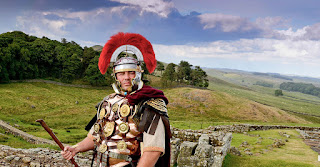
He’ll be joining me on my FFT adventures. He just needs a name.  I’m leaning towards Leo the Legionary but am open to suggestions!

My Roman Holiday (in the UK!)


There is something powerful about standing in a seemingly ordinary place in your community and learning that something extraordinary happened there. In Rochester, NY, we are surrounded by history but when teaching world history, I do not have this same sense of place or the understanding of how a site was shaped by the people who lived there and how time and culture helped to define a community, a country or a civilization.  While there are plenty of online and print materials to support curriculum development, the “being there” part that helps connect time and place to my students’ learning is missing. Making it meaningful and connected to our own community just adds to the challenge. 

This summer I plan to explore the ruins of Roman settlements and garrisons in Great Britain, in particular, trying to reconstruct what life was like for the Romans as well as the local population along Hadrian’s Wall. The Romans built the wall to keep the “barbarians” out, the citizens in, and yet both groups relied on each other for the trade of goods and labor. The irony is 2,000 years later, barriers continue to be built between “us” and “them,” whether they be physical barricades in the forms of walled borders and barbed wire, or more subtle socio-political and economic barriers.  While I have taught an expedition on the Roman Empire for several years now, I am looking for a way to re-invent the learning by looking at the Roman Conquest of Britain from multiple perspectives and have students take on these roles though research, debate, and reenactment.  My plan is to meet with local historians, historical re-enactors, museum educators and field archaeologists to learn what I can about life along Hadrian’s Wall and prepare my students for an expedition that will require them to think deeply and critically about the role of culture, power, public works, and the “other.” My guiding questions and complementary learning targets are as follows:

What can the artifacts of the past tell us about the people who lived there and then?
I can interpret ancient ruins and archaeological sites and explain their roles in both Roman and British history.
How do walls both protect and punish those on either side?
I can evaluate how the Romans, Picts and Britons viewed Hadrian’s Wall and interacted with it. 
Why do some cultures endure while others perish?
I can describe the legacy of Rome in the modern era.

The goal of visiting various Roman sites in Britain is to get a better sense of what life was like for Romans, living 1,400 miles away from the capital of the Empire. By exploring these sites in Britain, I will have a more complete picture of the breadth of the Roman Empire, its impact on local cultures and the impact local cultures had on the Romans. The idea of studying Hadrian’s Wall as a public work project piqued my interest. People settled by choice along the 73 miles of this stone and turf wall. Our identities are often forged by our sense of place and prejudices often emerge as a consequence. I hope to expand my historical worldview of these issues while also examining the divides of our own community. Our public works projects, however well intentioned, have consequences. I want to make that connection clear for my students and show them that two millennia on, we are still grappling for answers. I want to develop an expedition that better explores cultural diffusion and makes connections to present day issues of barriers in our own community.

But it won't be all research and reflection – my family is traveling with me and as much as I want them to be immersed in the Roman world, I know I am competing with tween and teen sensibilities and 21st century culture. It will be an interesting adventure, to be sure! So, follow the blog, leave comments, pose questions and live vicariously through my Fund for Teachers fellowship!

Saturday, April 18, 2015

Mind the (Blog) Gap


It’s Been a While

You know, I had every intention of keeping the blog alive. Then life happened. I think I probably penned six or seven drafts between then and now - just never finished them to the point of clicking the “publish” button. Well, that’s going to change. Between my work with the NY Educator Voice and my Fund For Teachers fellowship, I should really be publishing more. So I will. Just someone please hold me to it!